






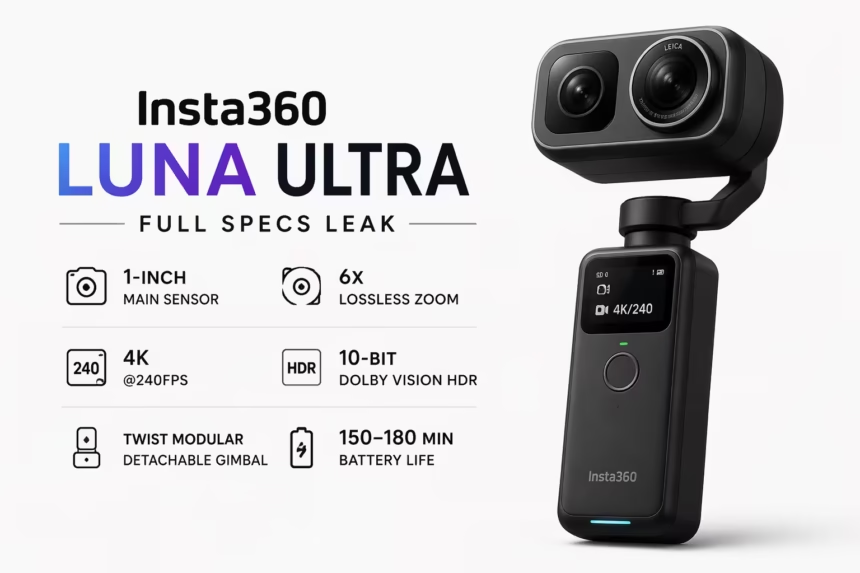
A full Luna Ultra spec sheet has surfaced 48 hours after Insta360’s frosted-glass NAB 2026 reveal and it answers almost everything the company refused to.
The Luna Ultra in 40 seconds
The Insta360 Luna Ultra is a dual-lens pocket gimbal camera with a 1-inch main CMOS sensor, a dedicated 1/1.3-inch telephoto sensor, Leica-calibrated optics, 3.9x optical (up to 6x lossless) zoom, 4K recording at 240fps with 10-bit Dolby Vision HDR, and a “Twist Modular” design that lets the gimbal head detach from the handle. Weight is under 150 g and a 1500 mAh cell delivers 150–180 minutes of recording. Launch is tipped for late Q2 2026, with May 15 as the most-cited date.
Quick-Reference Spec Sheet (leaked, unverified)
| Component | Luna Ultra Main/Wide | Luna Ultra Telephoto |
| Sensor | 1-inch CMOS | 1/1.3-inch CMOS |
| Focal length (35mm eq) | 18 mm | 70 mm |
| Aperture | f/2.0 (hands-on video hints at f/1.8) | f/2.8 |
| Color | 10-bit, Dolby Vision HDR, Leica-calibrated | 10-bit, Dolby Vision HDR |
| Max video | 4K @ 240fps | 4K @ 240fps |
| Dynamic range | ~14 stops (per official hands-on) |
- Zoom system: 3.9x optical · up to 6x lossless (in-sensor crop) · leaked footage suggests a 12x hybrid mode
- Display: 2-inch rotatable OLED, 1000 nits
- Design: “Twist Modular” detachable gimbal head · <150 g
- Battery: 1500 mAh · 150–180 minutes continuous recording · 15V/3A charging
- AI: Deep Track 3.0 subject tracking · dual-lens simultaneous recording
- Color profile: iLog (new Insta360 10-bit log)
- Launch: Late Q2 2026 (May 15 most widely tipped) alongside the single-lens
- Luna Pro Ecosystem: Launches with the new
- Insta360 Mic Pro wireless mic (E-Ink display)
What the leak actually confirms
Insta360 pulled an aggressive marketing move at NAB 2026 in Las Vegas: show the Luna Ultra behind frosted glass, seed pre-production units to a handful of creators, and let the hype build. The plan collapsed within 48 hours after a full spec comparison chart leaked on social media, with press-kit-quality imagery following shortly after.
Three things are now functionally certain:
1. It’s a dual-sensor system, not a single sensor with a fancy lens. The main module is a 1-inch CMOS at 18 mm equivalent, f/2.0 the same sensor class as the DJI Osmo Pocket 4’s primary camera. The telephoto module runs a 1/1.3-inch sensor at 70 mm equivalent, f/2.8 roughly the sensor size inside most flagship action cams (GoPro Hero 13, Insta360 Ace Pro 2). Both lenses are Leica co-engineered and can record simultaneously, which is the real sleeper feature for multi-angle content creators.
2. The zoom math doesn’t fully reconcile and that’s the story. The leak cites 3.9x optical and 6x lossless, but a 2x in-sensor crop on 3.9x would yield 7.8x, not 6x. Earlier rumors said 3x/6x; later rumors floated 6x/12x. Our read: Insta360 is almost certainly marketing the full “1× to 6× lossless” range end-to-end (wide-to-tele crop combined), with a hybrid 12x mode layered on top via sensor cropping at the tele end. Either way, it out-reaches the Osmo Pocket 4’s 2x lossless ceiling by a wide margin.
3. “Twist Modular” is the differentiator DJI can’t match. The gimbal head detaches from the handle. That single decision turns the Luna Ultra from a pocket gimbal into a body-mountable action cam, a tripod-ready cinema rig, and a confined-space vlogging camera all from one SKU. It echoes Insta360’s GO-series wearability DNA, but grafted onto a proper 1-inch-sensor gimbal body.
Imaging pipeline: what “Leica-calibrated, 10-bit, iLog” actually means for shooters
Every leaked spec sheet parrots “10-bit Dolby Vision HDR” without explaining the workflow implication, so here’s the dev-head version:
- 10-bit color depth = 1.07 billion colors per channel vs. 8-bit’s 16.7 million. Translation: smoother gradients in skies, skin, and low-light shadow rolloff; survivable color grading in DaVinci or Premiere without banding.
- Dolby Vision HDR = dynamic metadata per-frame. You’re not just capturing HDR you’re capturing HDR that streaming platforms (Apple TV+, Netflix, Disney+) can natively ingest without a secondary grade.
- iLog is Insta360’s new 10-bit log profile. Functionally similar to DJI’s D-Log M or Sony’s S-Log3 at the consumer tier. The footage hands-on creators have released at NAB shows ~14 stops of dynamic range, which lines up with what a 1-inch CMOS + 10-bit pipeline should deliver.
- Leica calibration is full-chain: optics, color science, and white-balance tuning. This is the same partnership logic Leica runs with Xiaomi on phones Insta360 gets credibility; Leica gets distribution.
For developers building content pipelines on top of this: assume the Luna Ultra outputs H.265/HEVC 10-bit 4:2:0 in Dolby Vision Profile 8.4, which is what the Osmo Pocket 4 does. We’ll update when the official codec matrix drops.
Insta360 Luna Ultra vs. DJI Osmo Pocket 4 the only comparison that matters
| Feature | Insta360 Luna Ultra (leaked) | DJI Osmo Pocket 4 |
| Sensor count | Dual (1-inch + 1/1.3-inch) | Single (1-inch) |
| Max optical zoom | 3.9x | 1x (prime) |
| Max lossless zoom | 6x | 2x |
| Max video | 4K @ 240fps | 4K @ 120fps |
| Log profile | iLog (10-bit) | D-Log M (10-bit) |
| HDR | Dolby Vision | Dolby Vision |
| Color partner | Leica | Hasselblad-adjacent (tuning in-house) |
| Modular/detachable head | Yes (Twist Modular) | No |
| Display | 2″ rotatable OLED, 1000 nits | 2″ rotatable OLED |
| Weight | <150 g | 179 g |
| Battery runtime | 150–180 min | ~166 min |
| US availability | Expected at launch | Delayed (regulatory) |
Why this matters commercially: DJI’s US launch delay is the strategic gift Insta360 needed. A US-available, dual-lens, detachable-gimbal camera with longer zoom reach and 2x the frame-rate ceiling isn’t a spec-sheet win it’s a market-capture window. Expect aggressive bundling at launch.
Release date and pricing what to actually expect
No official price has been confirmed. Our read of the leaks and the NAB 2026 timing:
- Launch event: Tipped for May 15, 2026 (late Q2).
- Expected pricing: Given the dual-sensor hardware and Leica branding, $699–$799 USD for the Luna Ultra is the realistic corridor. The single-lens Luna Pro will likely land at $499–$549, directly targeting the Osmo Pocket 4’s $799 price tier from below.
- Bundles to watch: Luna Ultra + Mic Pro + creator kit. Insta360’s playbook on the X5 and Ace Pro 2 suggests a $100–$150 upsell for the creator bundle.
FAQ
When is the Insta360 Luna Ultra release date?
The Luna Ultra is tipped for a launch in late Q2 2026, with May 15, 2026 as the most widely cited date. Insta360 has not officially confirmed.
Does the Insta360 Luna Ultra have optical zoom?
Yes. The Luna Ultra has a dedicated telephoto lens with a 70 mm equivalent focal length, delivering 3.9x optical zoom. With a 2x in-sensor crop it pushes to 6x lossless, and leaked footage suggests a hybrid mode reaches up to 12x.
Is the Luna Ultra better than the DJI Osmo Pocket 4?
On paper, yes in four categories: zoom reach (6x lossless vs. 2x), frame rate (4K/240fps vs. 4K/120fps), modularity (detachable gimbal head vs. fixed), and US availability (immediate vs. delayed). The Osmo Pocket 4 still has a more mature ecosystem and color science.
What is Twist Modular Design?
Twist Modular is Insta360’s term for the Luna Ultra’s detachable gimbal head, which separates from the handle. This allows body mounting, confined-space filming, and tripod-mounted cinema rigs from a single device functionality no other 1-inch-sensor gimbal camera offers.
Does the Luna Ultra shoot in 10-bit?
Yes. Both the main and telephoto lenses support 10-bit color depth, Dolby Vision HDR, and a new iLog color profile co-developed with Leica.
What sensor does the Insta360 Luna Ultra use?
The Luna Ultra uses two sensors: a 1-inch CMOS on the main wide-angle lens (18 mm equivalent, f/2.0) and a 1/1.3-inch CMOS on the telephoto lens (70 mm equivalent, f/2.8).
The verdict (for now)
The Luna Ultra isn’t a DJI killer. It’s something more dangerous: the first pocket gimbal that refuses to pick a lane. Action cam, vlogging rig, cinema B-cam, multi-angle content machine the Twist Modular hardware lets it be all four. If Insta360 nails the price and ships on time while DJI is still untangling US regulatory delays, this is the product that fragments the category.
We’ll update this article the moment Insta360 makes anything official.


