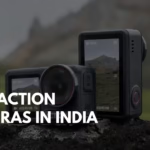





The DJI Osmo Action 3 is DJI’s third-generation take on action cameras aiming to combine durability, good video quality, dual screens, improved battery life, and a more practical mounting system. It’s built for adventure seekers, vloggers, and anyone who wants reliable performance without going into top-price flagship territory. Here’s a complete breakdown of what makes it great, where it falls short, and whether it’s the right pick for you.
Key Features & Specifications
What’s Good / What’s New Compared to Previous or Rival Models
- Design is more practical: The switch back to a frame-&-mount system plus dual screens is a plus for versatility.
- Waterproof improvements: 16m depth without case is decent; more resilient for snorkeling, swimming, etc.
- Better battery & cold temperature performance: With “Extreme Battery” option and claims of better performance in colder conditions.
- Competitive pricing: Offers a lot of features that rival action cams charge more for. Value is a strong point according to many reviews.
Real-World Performance
Video & Image Quality
In daylight, the Action 3 produces sharp, vivid 4K footage. Colors and horizon levels are generally good. HDR helps with handling bright/dark contrast. In low light, there is noise, especially at higher ISOs or fast framerate modes. The 12 MP photo mode is fine for casual use but not benchmark for pixel-peeping.
Stabilization & Mounting
RockSteady 3.0 is reliable. The magnetic quick release mount makes mounting/unmounting faster and more flexible than many rival systems. The frame allows for effortless switching of orientation (horizontal ↔ vertical), which is helpful for social media content.
Battery & Temperature
Battery holds up well in moderate use. Using the Extreme Battery and moderate settings extends runtime. Performance dips somewhat in cold conditions, but less severely than older models. Charging time is reasonable. The dual screens add convenience but also draw some power.
Durability & Use Cases
Good for outdoor/adventure, water sports (snorkeling, surface water, etc.). The rugged frame and durable lens guard means less worry about minor knocks. The ability to reach 16m without housing is useful. But for deep diving, separate housing needed.
Strengths & Weaknesses
Pros
- Dual screens (front + back) great for selfies, vlogging, framing.
- Excellent mounting system (magnetic + quick release), plus frame for vertical/horizontal.
- Robust waterproof capability without extra housing.
- Strong battery endurance and options for cold climate use.
- Value: lots of features at competitive price.
Cons
- No 5K+ resolution (some rivals offer 5.3K, etc.) — limits leeway for cropping or extra detail.
- Low light performance isn’t best in class; image noise shows up.
- Photography modes are modest compared to some high-end cameras.
- Horizon leveling (360°) limited depending on resolution.
- Heavier than simplest action cams; size may be a factor for ultra-light setups.
Comparisons
| Competing Model | Osmo Action 3 Advantages | Where Competitors Outperform |
| GoPro Hero 11 / Hero10 | Better waterproof rating (16m vs ~10-12m in some), magnetic mount convenience, strong stabilization, usually lower cost. | GoPro tends to have better low light sensors/resolutions (5-5.3K), bigger app/ecosystem, more accessories. |
| DJI Action 2 | More rugged build; no need for modular extra pieces; dual screens and easier mounting. | Action 2 has more creative modular attachments; maybe lighter or more compact in some setups. |
| Insta360 X-series | Osmo Action 3 is simpler, more rugged, better suited for classic action cam use; good handling. | Insta360 may offer 360-capture, higher resolution, more creative reframing. |
Who This Is For
- Adventure / Action enthusiasts who need durability and reliable performance.
- Vloggers & social creators who benefit from dual screens and quick orientation changes.
- Outdoor / water sports users needing good waterproofing and rugged build.
- People who want a strong action camera without premium flagship pricing.
Not ideal if:
- You need bleeding-edge resolution (5K+).
- You shoot a lot in very low light or want high picture detail.
- You want the tiniest form factor possible.
FAQs
Q1: What’s the maximum video resolution and framerate?
Up to 4K 120 fps, plus 1080p up to 240 fps for slow motion.
Q2: How deep can it go underwater without housing?
Up to 16 meters without a housing; with a waterproof case you can go deeper (~60 m).
Q3: What kind of storage is needed?
microSD cards up to ~256 GB supported. For high-bitrate 4K / 120 fps, use fast UHS-I / UHS-II cards that meet write speed requirements.
Q4: How’s the battery life?
Good for its class. With moderate settings and using the Extreme Battery, gets strong usage. Battery life does drop under high frame rate, 4K shooting, cold temperatures.
Q5: Does it have Horizon leveling / 360° leveling?
Yes, horizon leveling (HorizonSteady) is included, but full 360° leveling is available only up to certain resolutions (e.g. 2.7K) depending on settings.
Q6: Can it be used as a webcam?
Yes, via USB-C it supports webcam mode.
Q7: What’s the weight & size?
About 145 grams; compact yet sturdy build. Dimensions approx 70.5 × 44.2 × 32.8 mm.
Q8: How is audio quality?
Has three microphones with active wind-noise suppression. Good for action, vlogging; but for pro audio you may still want external mic.
Verdict
The DJI Osmo Action 3 is a well-rounded action camera that strikes a strong balance between performance, durability, and value. It doesn’t offer the ultra-high resolution of some premium options, but its rugged waterproof design, excellent mounting system, dual screens, and stable performance make it an excellent option for many users. If you want a reliable all-rounder for outdoor adventures or content creation without breaking the bank, the Action 3 is one of the best choices in its class.