



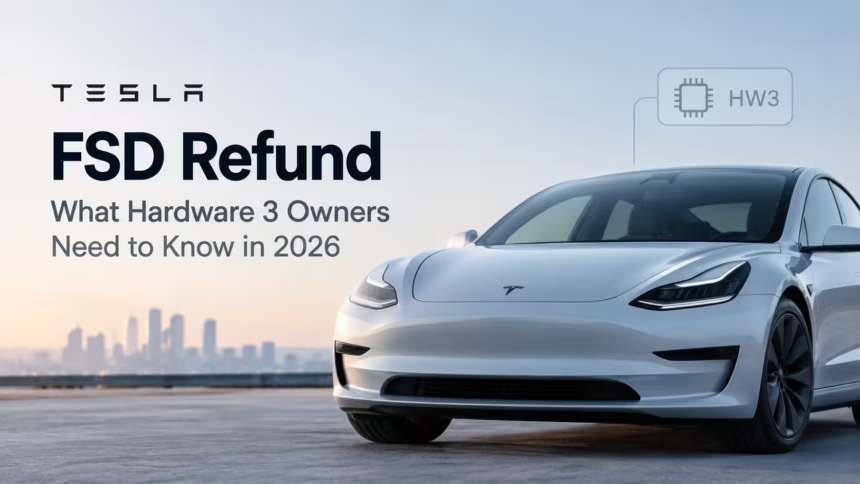
Tesla’s Full Self-Driving promise has entered a difficult new phase.
Owners of older Tesla vehicles equipped with Hardware 3 (HW3) have been told that their cars cannot achieve unsupervised Full Self-Driving through a software update alone. That is significant because Tesla previously promoted its vehicles as having the hardware needed for future autonomous driving capabilities.
Tesla CEO Elon Musk acknowledged the HW3 limitation during Tesla’s first-quarter 2026 earnings call, saying that Hardware 3 does not have enough capability to achieve unsupervised FSD. Tesla has discussed upgrading affected vehicles, but questions remain about the cost, timing and whether owners who paid for FSD can obtain refunds.
For U.S. Tesla owners, the biggest question is simple:
Can Tesla HW3 owners get their FSD money back?
The answer is more complicated than a simple yes or no.
Quick Answer: Are Tesla HW3 Owners Getting FSD Refunds?
Tesla has not announced a blanket refund program for all HW3 owners who purchased FSD.
Tesla has discussed possible hardware retrofits and other solutions for affected vehicles, while some customers have pursued refunds or legal claims.
Tesla’s current support documentation also says refunds are not available for FSD subscriptions. Separately, Tesla’s upgrade policy says certain app-purchased upgrades can be refunded within 48 hours, subject to its stated conditions.
That distinction matters.
A customer asking for a refund because their HW3 vehicle cannot eventually deliver unsupervised FSD is dealing with a different issue from someone canceling a monthly FSD subscription.
What Happened to Tesla’s FSD Hardware 3 Promise?
Tesla’s long-running autonomy strategy depended heavily on the idea that vehicles could become increasingly capable through software updates.
Many Tesla vehicles built with Hardware 3 were marketed around the expectation that future software improvements would unlock increasingly advanced autonomous-driving capabilities.
The problem became more apparent when Tesla determined that HW3 does not have sufficient computing capability for the company’s intended unsupervised FSD system.
Musk said HW3 has roughly one-eighth the memory bandwidth of Hardware 4, identifying memory bandwidth as an important limitation for unsupervised FSD.
This creates a fundamental hardware problem:
Software can improve what existing hardware does, but software cannot create additional physical computing resources.
That is why the HW3 issue is much more serious than an ordinary delayed Tesla software feature.
Which Tesla Vehicles Have Hardware 3?
Hardware 3 was installed in a large number of Tesla vehicles produced before the transition to newer hardware.
Generally, Tesla vehicles produced around 2019 through 2023 can be associated with HW3, although owners should verify the actual hardware configuration of their individual vehicle rather than relying solely on the model year.
Potentially affected vehicles include versions of:
- Tesla Model 3
- Tesla Model Y
- Tesla Model S
- Tesla Model X
However, not every Tesla from these model years necessarily has exactly the same hardware configuration, so owners should check their vehicle directly.
The key issue isn’t simply the Tesla model.
It is the FSD computer and camera hardware installed in that particular vehicle.
Hardware 3 vs. Hardware 4
The difference between Tesla HW3 and HW4 has become increasingly important for FSD owners.
| Feature | Hardware 3 | Hardware 4 |
| Older generation | Yes | No |
| Used in earlier Tesla vehicles | Yes | Yes |
| Designed for advanced FSD | Yes | Yes |
| Sufficient for Tesla’s intended unsupervised FSD | Tesla says no | Tesla’s newer platform |
| Hardware upgrade discussed | Yes | Not applicable |
| Owner uncertainty | High | Lower |
The critical point is that HW3 wasn’t necessarily useless for FSD.
Tesla’s current FSD system can operate on supported vehicles, but that doesn’t mean HW3 can ultimately deliver the level of autonomous driving Tesla now expects from its newer systems.
Is Tesla FSD Actually Fully Self-Driving?
This is another important distinction for U.S. consumers.
Despite its name, Tesla’s current consumer product is officially called Full Self-Driving (Supervised).
Tesla’s own documentation states that FSD (Supervised) requires the driver to remain attentive and responsible for the vehicle.
Therefore:
FSD (Supervised) ≠ an autonomous car that can operate without human supervision.
This distinction becomes especially important when discussing the HW3 controversy.
The current dispute isn’t simply:
“Does FSD work on HW3?”
It is:
“Can an HW3 Tesla eventually achieve the unsupervised autonomous-driving capability that customers were led to expect?”
That is a much more important question.
Why Are Tesla Owners Asking for Refunds?
There are several reasons.
1. Owners paid for future capability
Some Tesla customers paid thousands of dollars for FSD based partly on the expectation that future software updates would unlock greater autonomy.
Notebookcheck reports historical FSD purchase prices of approximately $6,800 to $10,000 for affected vehicles.
For an owner who paid thousands of dollars, discovering that the vehicle’s computer may not be capable of the promised future functionality is understandably significant.
2. A software update may not solve the problem
Tesla’s current position is that HW3 doesn’t have enough capability for unsupervised FSD.
That means simply waiting for another software update may not resolve the underlying limitation.
3. Owners don’t necessarily want a new car
Tesla has discussed solutions involving newer hardware or moving owners toward newer vehicles.
But an owner who already owns a paid-off Model 3 or Model Y may not want to purchase another Tesla simply to receive the autonomous-driving capability they expected their existing vehicle to eventually receive.
Will Tesla Give HW3 Owners a Free Hardware Upgrade?
This remains one of the biggest unanswered questions.
Tesla has discussed a potential retrofit involving hardware changes, including the computer and cameras. Musk also discussed the possibility of specialized facilities to handle the scale of such upgrades.
But that does not mean every HW3 owner currently has a guaranteed free retrofit.
As of now, owners should not assume that Tesla has established a universal, no-cost HW3-to-HW4 conversion program.
That distinction is critical.
Possible retrofit ≠ confirmed free retrofit.
Can Tesla FSD Owners Get a Refund?
There are several different situations that should not be confused.
FSD subscription
Tesla’s current support page says refunds are not available for FSD subscriptions. Customers can cancel the subscription and retain access through the end of the billing period.
Recently purchased upgrades
Tesla separately says certain upgrades purchased through the Tesla app can be eligible for a refund request within 48 hours, subject to its conditions.
Older FSD purchase and HW3 capability dispute
This is the complicated category.
A customer who purchased FSD years ago and argues that Tesla failed to deliver a promised future capability is dealing with a potential consumer/legal claim, not Tesla’s ordinary subscription-refund policy.
Tesla’s SEC filings show that the company is facing litigation involving claims concerning statements about Autopilot and FSD capabilities. The filings also disclose a separate consumer lawsuit filed in California in June 2026 alleging statements concerning Tesla’s driver-assistance technology. Tesla says it intends to defend these matters.
Therefore, owners should not interpret Tesla’s subscription policy as automatically resolving every potential HW3 FSD refund claim.
Are There Tesla FSD Lawsuits?
Yes.
Tesla’s regulatory filings disclose multiple legal matters involving allegations related to its driver-assistance and FSD representations.
One important case involves claims about statements concerning the capabilities of Full Self-Driving and Autopilot. Tesla’s filing says the case includes litigation over alleged representations about these technologies.
There are also consumer-organized efforts outside the United States focused on HW3 owners.
For example, a European HW3 campaign says thousands of Tesla owners have joined an effort seeking compensation related to the company’s autonomous-driving promises.
However, U.S. Tesla owners should not assume that an overseas collective action automatically gives them a refund or legal remedy in the United States.
What Should Tesla HW3 Owners Do Now?
If you own a Tesla with Hardware 3 and paid for FSD, don’t immediately assume that you are entitled to a refund.
Instead, document your situation.
Step 1: Identify your Tesla’s hardware
Check the vehicle’s software/hardware information and determine whether your Tesla has HW3 or a newer FSD computer.
Step 2: Check your FSD purchase history
Save:
- Original FSD invoice
- Purchase date
- Amount paid
- Vehicle VIN
- Tesla order documents
- Screenshots of relevant Tesla communications
Step 3: Keep records of Tesla’s representations
If you have historical Tesla emails, purchase pages or other documentation describing future FSD capabilities, preserve them.
Don’t rely exclusively on screenshots circulating on social media.
Step 4: Contact Tesla
Ask Tesla specifically:
Is my vehicle eligible for the hardware required for unsupervised FSD?
And:
If not, what remedy is Tesla offering for customers who purchased FSD?
Get the response in writing whenever possible.
Step 5: Don’t confuse FSD Supervised with unsupervised autonomy
Tesla’s current FSD product still requires supervision.
That distinction should be included in any complaint, refund request or legal discussion.
What Tesla’s Current FSD Position Means for HW3 Owners
The biggest takeaway is that this isn’t simply a story about Tesla delaying another software feature.
It is a hardware-capability dispute.
Tesla has acknowledged that HW3 cannot achieve its intended unsupervised FSD capability through software alone.
At the same time, Tesla continues to develop autonomous driving and has expanded its robotaxi efforts.
In September 2026, Tesla launched its purpose-built Cybercab robotaxi service in Austin, Texas. The Cybercab does not have a conventional steering wheel or pedals, highlighting how far Tesla’s autonomous-driving strategy has moved beyond the capabilities expected of earlier consumer vehicles. U.S. regulators are scrutinizing the deployment.
That creates an unusual situation:
Tesla is simultaneously moving toward true driverless transportation while some earlier Tesla owners are still waiting to learn what happens to the autonomy capability they originally expected from their existing cars.
Tesla FSD Refund: The Bottom Line
Tesla HW3 owners have a legitimate reason to pay attention to the FSD situation.
The company has acknowledged that Hardware 3 does not have the capability required for its intended unsupervised FSD system.
But that does not mean every HW3 owner automatically receives a $6,800, $10,000 or other FSD refund.
Tesla has not announced a blanket refund for all affected owners.
The company has discussed hardware retrofit possibilities, while Tesla’s normal FSD subscription policy says subscriptions aren’t refundable.
For U.S. owners, the most important things to watch are:
- Whether Tesla announces a formal HW3 retrofit program
- Whether the retrofit is free or paid
- Whether Tesla offers refunds or other compensation
- How ongoing U.S. litigation develops
- Whether courts determine that Tesla’s historical FSD representations created enforceable obligations
Until Tesla provides a universal remedy, HW3 owners should preserve their purchase records and verify their individual vehicle hardware rather than assuming that a refund or free upgrade is guaranteed.
FAQ: Tesla FSD Refund and Hardware 3
Can Tesla HW3 run FSD?
Yes, supported HW3 vehicles can run Tesla’s current FSD (Supervised) system. However, Tesla has acknowledged that HW3 cannot achieve the company’s intended unsupervised FSD capability.
Can Tesla HW3 get unsupervised FSD?
Tesla CEO Elon Musk said HW3 does not have sufficient capability to achieve unsupervised FSD.
Will Tesla replace HW3 for free?
Tesla has discussed potential retrofit solutions, but owners should not assume that a universal free retrofit is currently guaranteed.
Can I get a Tesla FSD refund?
It depends on what you purchased and your circumstances. Tesla says FSD subscriptions aren’t refundable, while certain recently purchased app upgrades may qualify for refunds under specific conditions. Older FSD purchases involving the HW3 capability dispute are a separate matter.
Which Teslas have Hardware 3?
Many Tesla vehicles produced roughly between 2019 and 2023 were equipped with HW3, but owners should verify their specific vehicle rather than relying only on model year.
Is Tesla FSD fully autonomous?
Tesla’s current consumer product is called Full Self-Driving (Supervised), and Tesla requires the driver to remain attentive and responsible for the vehicle.